Research 1
Using pictographs to investigate the neural mechanisms that differentiate word and object processing
Words and objects are two foundational pillars of human visual cognition: the former constitutes the core symbolic system through which civilization is transmitted, while the latter underpins the basic cognitive capacity that enables individuals to interact with the physical world. For this reason, uncovering the neural differences between the two has become a key entry point for probing the mysteries of higher human cognition. For decades, however, comparative studies of the brain mechanisms for word and object recognition have been constrained by a central bottleneck: the visual features (e.g., letter forms vs. object contours) as well as phonological and semantic properties of the two stimulus categories are difficult to fully match, and experimental tasks often differ as well. As a result, it has been hard to determine whether observed neural differences truly reflect intrinsic cognitive mechanisms or instead arise from extrinsic stimulus properties or task demands. Chinese pictographs, a distinctive crystallization of wisdom in Chinese culture, offer a way to break this impasse. Originating from the ancient practice of “observing objects and capturing their forms,” pictographs use simple strokes to sketch prototypical object features, thereby combining the immediacy of object-like images with the abstraction of written symbols. From the oracle-bone script form of the character “舟” (boat), resembling a small vessel, to the regular-script form of “山” (mountain), evoking layered peaks, pictographs can function both as written symbols conveying meaning and as visual images depicting objects. Leveraging this “dual nature” of pictographs, Prof. Zaizhu Han’s team designed 20 pictographic stimuli, each of which can be recognized either as a Chinese character or as an object. To further minimize confounds from task demands, the team adopted a “single-task, dual-identification” experimental design. The results indicate that a key neural “code” for distinguishing word from object recognition lies in the inferior parietal lobule (IPL) and the anterior cingulate cortex (ACC), together forming a parietal–cingulate network.
人类视觉认知的“两大支柱”——文字与物体,前者是人类文明传承的核心符号系统,后者是个体与物理世界互动的基础认知能力。正因如此,探究二者的神经机制差异,成为探究人类高级认知奥秘的关键切入点。长期以来,文字与物体识别的脑神经机制对比研究受限于一个关键瓶颈:两类视觉刺激的视觉特征(如字形与物体轮廓)、语音或语义属性难以完全匹配,实验任务也时常不同,导致无法明确观察到的神经差异究竟源于内在认知机制,还是外在刺激特性或任务需求。而象形文字,作为中华文化独特的智慧结晶,为这一困境提供了破局之道。象形文字由古人“观物取象”而来,以简洁的线条勾勒出物体的典型特征,从而兼具物体图像的直观性与文字符号的抽象性。从甲骨文中一叶扁舟状的“舟”字,到楷书中峰峦叠嶂状的“山”字,象形文字既可以作为传递语义的文字符号,也能被视作描绘物体的视觉图像。韩在柱教授团队借助象形文字这一“双重属性”,设计了20个象形刺激,每个象形刺激均可同时被识别为汉字或者物体。为进一步排除任务需求对实验结果的干扰,课题组采用了“同一任务双识别模式”实验设计。结果表明,大脑区分文字与物体识别的关键“密码”——顶下小叶(inferior parietal lobule,IPL)与前扣带皮层(anterior cingulate cortex,ACC)及其构成的“顶叶-扣带网络”。
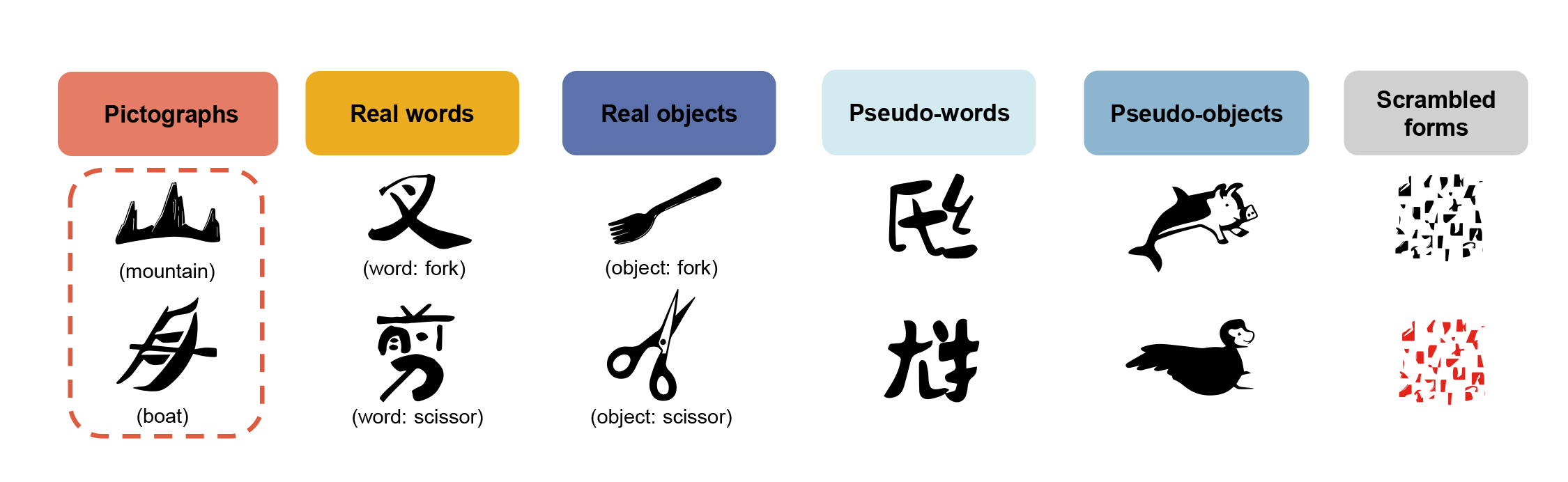
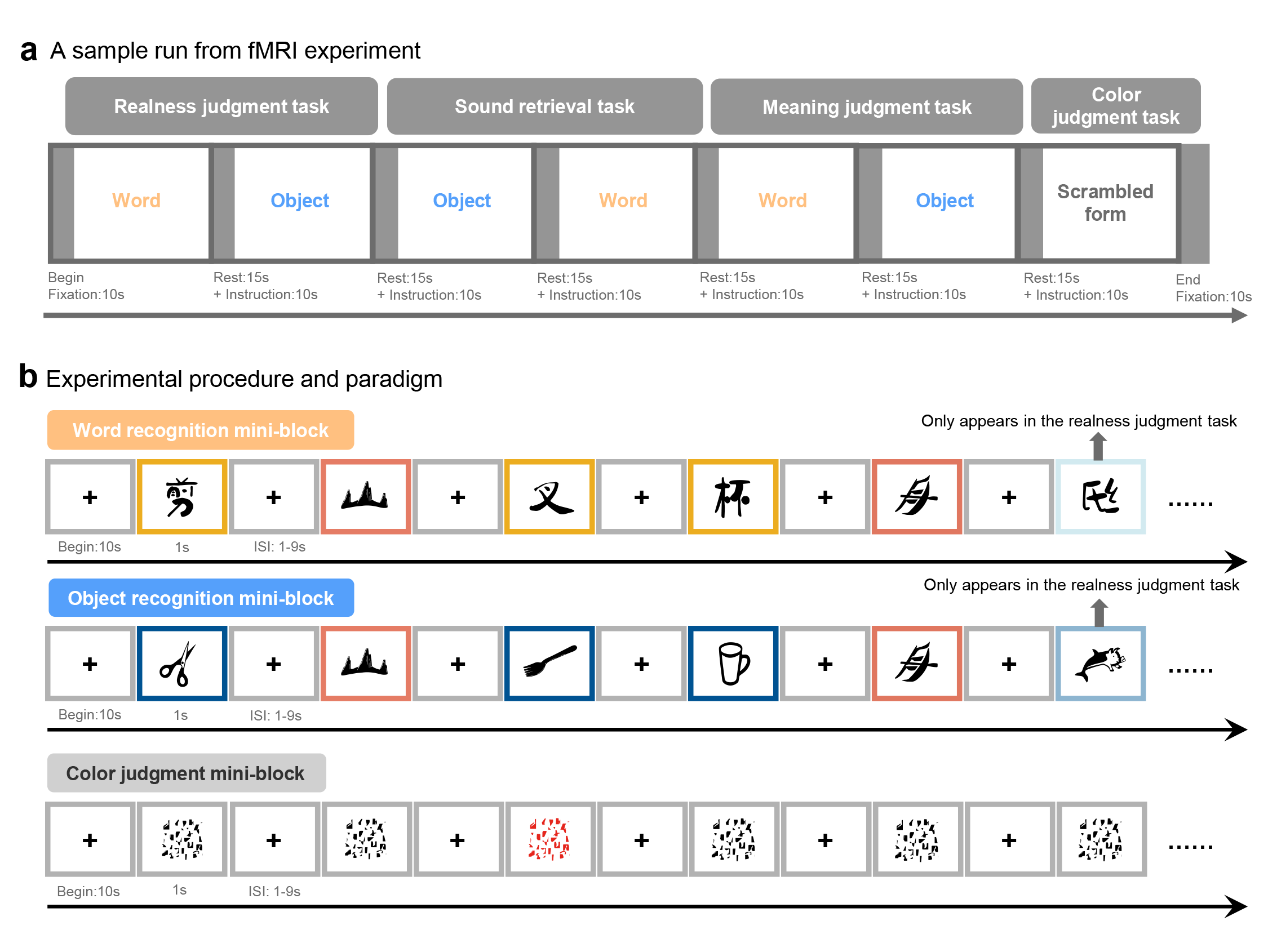
Figure: The stimuli and procedure for Chinese pictograph tasks.
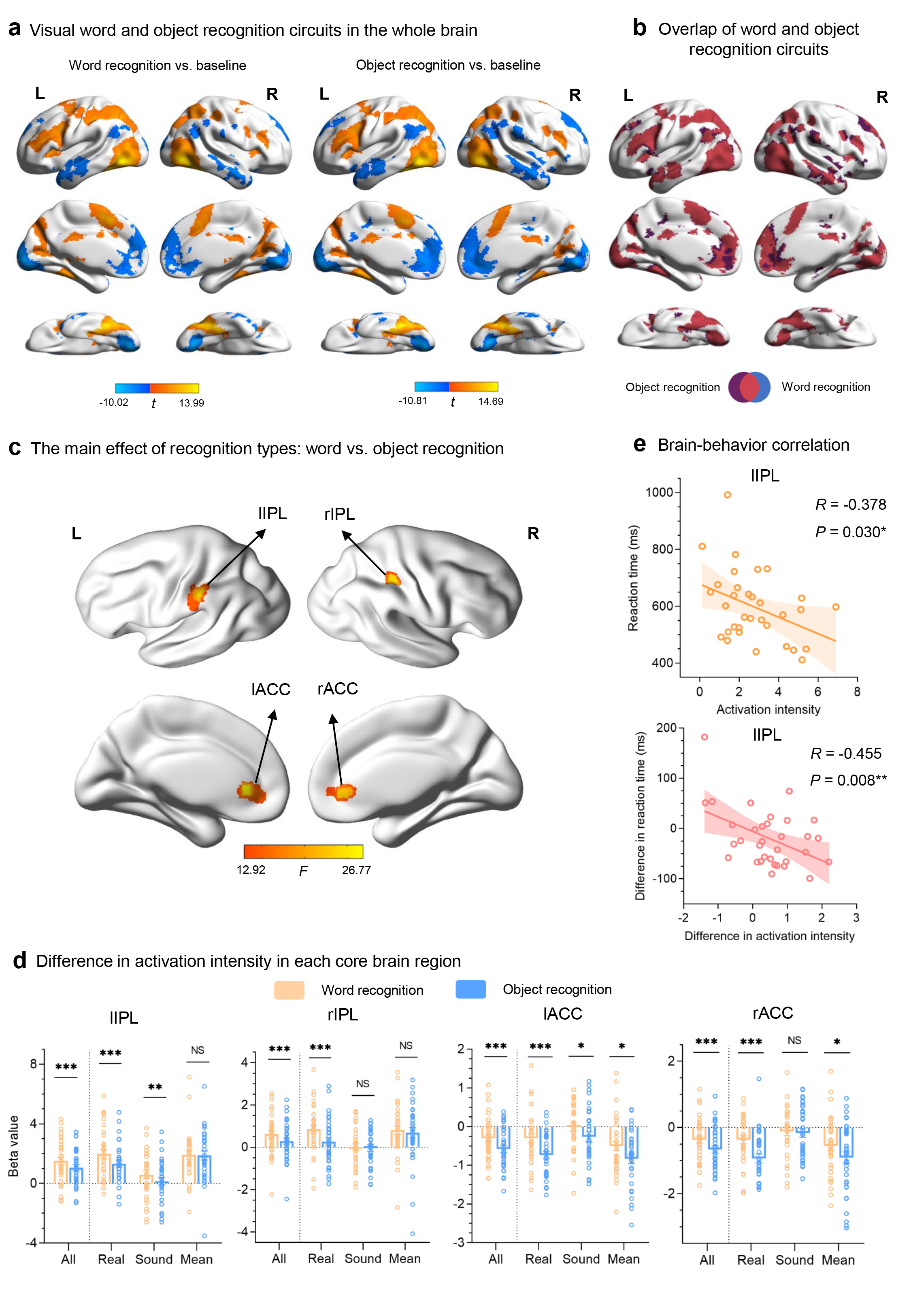
Figure: The results for Chinese pictograph tasks.
Major findings:
Zeng, J., Luo, Y., Luo, X., Jiao, S., Wang, K., Cui, Z., ... & Han, Z.* (2025). Neural distinction between visual word and object recognition: An fMRI study using pictographs. Journal of Neuroscience, 45(28). PDF
Research 2
White-Matter Structural Networks Underlying Chinese Language Processing
汉语加工的脑白质结构网络
By integrating behavioral performance on Chinese language tasks with diffusion tensor imaging data, we constructed white-matter fiber networks supporting orthographic, phonological, and semantic processing in Chinese. Our findings reveal that the semantic network constitutes a complex architecture formed by multiple fiber bundles, among which the tract connecting the left fusiform gyrus and the collateral sulcus conveys color-related conceptual knowledge of objects. The phonological network comprises major pathways such as the left superior longitudinal fasciculus (SLF), the anterior thalamic radiation (ATR), and the inferior fronto-occipital fasciculus (IFOF), whereas the left inferior longitudinal fasciculus (ILF) predominantly transmits orthographic information. Moreover, we delineated the spatial intersections between the language network and other cognitive systems, including the executive-control network.
通过对汉语加工测试成绩与弥散张量成像数据的相关分析,构建起了加工汉语形、音、义的白质纤维网络。主要发现,语义网络是由多条纤维束组成的复杂网络,其中左侧梭状回-距状裂之间的纤维束传递物体语义的颜色类知识。左侧上纵束(SLF)、丘脑放射前束(ATR)、下额枕束(IFOF)等组成语音加工网络,而左侧下纵束(ILF)传递字形信息。同时,还描绘出了语言网络与其他认知网络(如执行控制网络)的交叠情况。
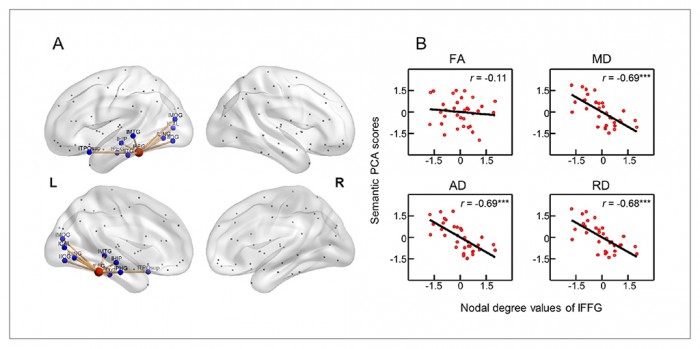
Figure:The semantic hub region in patients with semantic dementia.
A) The left lateral fusiform gyrus (LFFG, highlighted in red) identified as the central semantic hub and its nine connected cortical regions.
B) The association between the node degree of the left fusiform gyrus and performance on semantic tasks.
Major findings:
Chen Y#, Huang L#, Chen K, Ding J, Zhang Y, Qing Y, Lv Y, Han Z*, Qihao Guo*. (2020). White matter basis for the hub-and-spoke semantic representation: evidence from semantic dementia. Brain, 143: 1206-1219. PDF
Ke Wang, Xiaonan Li, Ruiwang Huang, Junhua Ding, Luping Song, Zaizhu Han*. (2020). The left inferior longitudinal fasciculus supports orthographic processing: Evidence from a lesion-behavior mapping analysis. Brain and Language, 201:104721 PDF
Ding J#, Chen K#, Zhang W, Li M, Chen Y, Yang Q, Lv Y, Guo Q*, Han Z*. (2017). Topological Alterations and Symptom-Relevant Modules in the Whole-Brain Structural Network in Semantic Dementia. Journal of Alzheimer’s Disease, 59: 1283-1297. PDF
Li M, Zhang Y, Song L, Huang R, Ding J, Fang Y, Xu Y, Han Z*. (2017). Structural connectivity subserving verbal fluency revealed by lesion-behavior mapping in stroke patients. Neuropsychologia, 101: 85-96. PDF
Bi Y, Han Z*, Zhong S, Ma Y, Gong G, Huang R, Song L, Fang Y, He Y, Caramazza A. (2015). The white matter structural network underlying human tool use and tool understanding. The Journal of Neuroscience, 35: 6822-6835. PDF
Research 3
Gray-matter functional network for Chinese language processing
汉语加工的脑灰质功能网络
Using correlation analyses between behavioral performance on Chinese language tasks and three-dimensional gray-matter imaging as well as resting-state functional neuroimaging data, we identified the key hub regions underlying Chinese language processing and reconstructed the corresponding functional network. The major findings indicate that the left temporal lobe, hippocampus, and cingulate gyrus constitute critical hub regions. Building on these discoveries, we further developed computational models of anterior temporal-lobe function that account for the processing of different categories of information (e.g., language, face recognition, and disinhibition).
Anchored on these core language-related regions, we employed functional connectivity analyses to delineate the brain network supporting Chinese language processing. Notably, hippocampal connectivity with the anterior temporal lobe and middle temporal gyrus was found to support semantic processing; connectivity between the precuneus and the parahippocampal gyrus, inferior temporal gyrus, and inferior/middle frontal gyri was implicated in noun processing; whereas connectivity between the middle/superior temporal gyri and the inferior frontal gyrus/insula and middle occipital gyrus was implicated in verb processing.
通过对汉语加工测试成绩和灰质3D、功能态神经影像学数据的相关分析,找到了加工汉语的关键hub脑区,并构建了与此对应的功能网络。主要发现,左脑颞叶、海马、扣带回是的关键hub脑区,并对构建了颞叶前部加工不同类信息(如,语言、面孔识别、去抑制)的神经计算模型。以这些关键语言脑区为核心,通过功能连接分析技术,建立了语言加工的脑功能网络。其中,发现海马与颞叶前部、颞中回的功能连接参与语义加工;楔前叶与海马旁回、颞下回、额下回/额中回的功能连接参与名词加工,而颞中回/颞上回与额下回/脑岛、枕中回的功能连接参与动词加工。
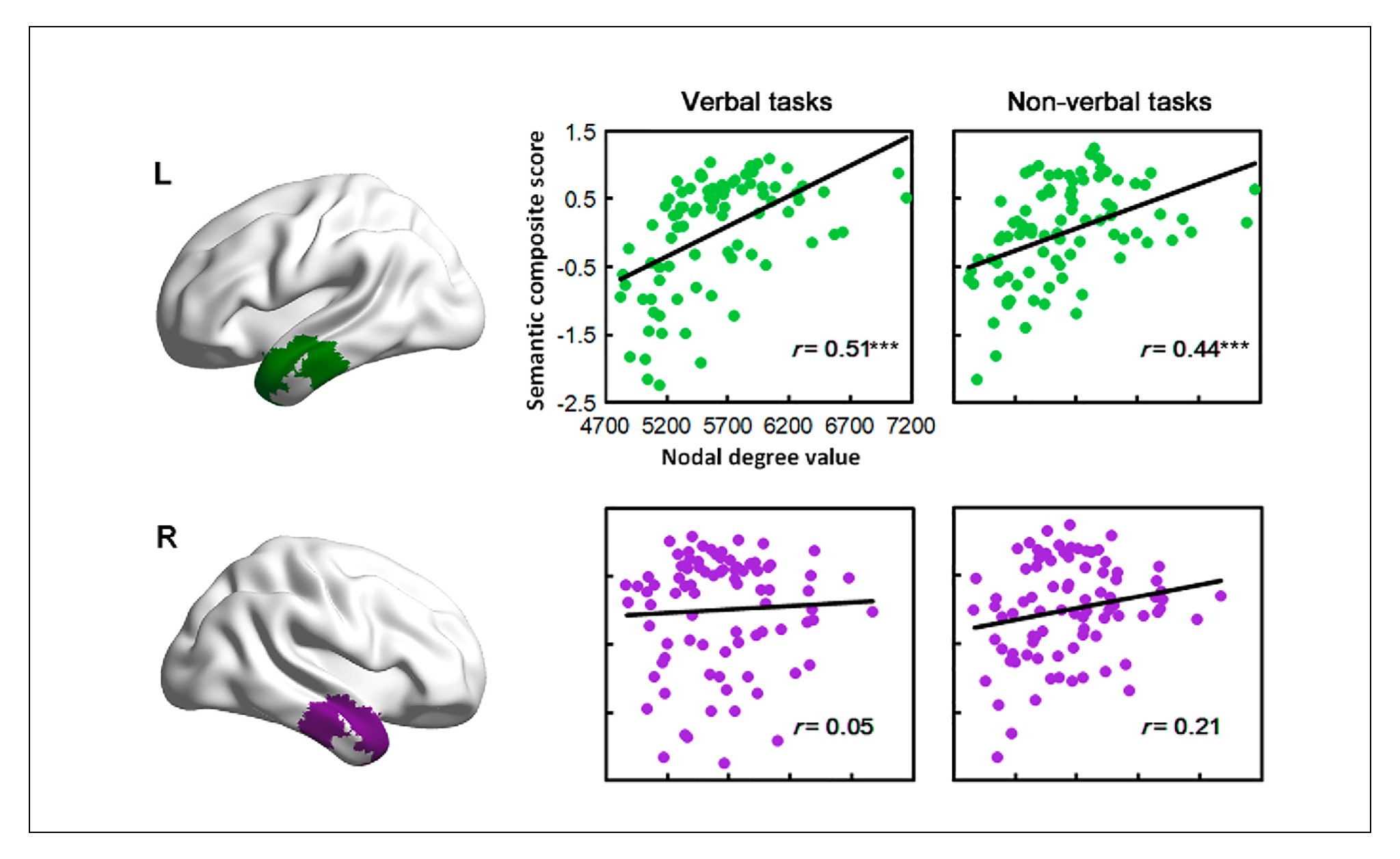
Figure. Comparative correlations between bilateral anterior temporal-lobe regions and different semantic performance measures.
Major findings:
Ding J#, Chen K#, Liu H, Huang L, Chen Y, Ying R, Yang Q, Guo Q*, Han Z*, Lambon Ralph M*. (2020). A unified neurocognitive model of semantics language social behaviour and face recognition in semantic dementia. Nature Communications, 11: 2595. PDF
Chen Y#, Chen K#, Ding J, Zhang Y, Yang Q, Lv Y, Guo Q, Han Z*. (2019). Neural substrates of amodal and modality-specific semantic processing within the temporal lobe: A lesion-behavior mapping study of semantic dementia. Cortex, 120: 78-91. PDF
Zhao Y, Song L, Ding J, Lin N, Wang Q, Du X, Sun R, Han Z*. (2017). Left anterior temporal lobe and bilateral anterior cingulate cortex are semantic hub regions: evidence from behavior-nodal degree mapping in brain-damaged patients. The Journal of Neuroscience, 37: 141-151. PDF
Chen Y, Chen K, Ding J, Zhang Y, Yang Q, Lv Y, Guo Q, Han Z. (2017). Brain Network for the Core Deficits of Semantic Dementia: A Neural Network Connectivity-Behavior Mapping Study. Front Hum Neurosci.11:267. PDF
CAoCA汉语失语症认知评估系统软件V1.0 (CAoCA Chinese Aphasia Cognitive Assessment System Software v1.0)
Research 4
Plasticity of the Chinese Language Neural Network
汉语神经网络的可塑性变化规律
To investigate how experience-dependent learning shapes the plasticity and developmental trajectory of the neural network for language, our research group conducted training experiments in which healthy adults learned novel symbols as Chinese characters, as well as fMRI studies in individuals with congenital sensory deprivation. The results showed that when meaningless visual forms were trained to be recognized as Chinese characters or as objects, the visual word form area (VWFA) exhibited selective activation only for items learned as characters. Moreover, functional connectivity between the VWFA and other higher-order language regions was strengthened following character learning.
Compared with neurotypical individuals, congenital deaf participants showed markedly reduced functional connectivity between the VWFA and the auditory speech region (left superior temporal gyrus). Congenitally blind individuals also exhibited distinct VWFA connectivity patterns relative to sighted controls. These findings demonstrate that the neural network for Chinese language develops through the joint contributions of both innate and experience-dependent factors.
为了探讨语言神经网络受后天学习经验的可塑性影响及其发展变化规律,课题组开展了正常人的学习汉字训练实验和先天感觉通道缺失个体的功能磁共振成像(fMRI)实验。结果发现,当把无意义图形学习为汉字和物体时,字形加工脑区(VWFA)只有对学习为汉字的试次出现选择性激活,而且这个脑区和其他高级语言区的功能连接也有所增强。与正常人相比,先天聋人的这一脑区与听觉言语区(左侧颞上回)之间的功能连接明显减弱,先天盲人这一区域与其他脑区的功能连接模式也与正常人存在差异。这些结果表明,汉语的神经网络在先天和后天因素共同作用下协同发展。
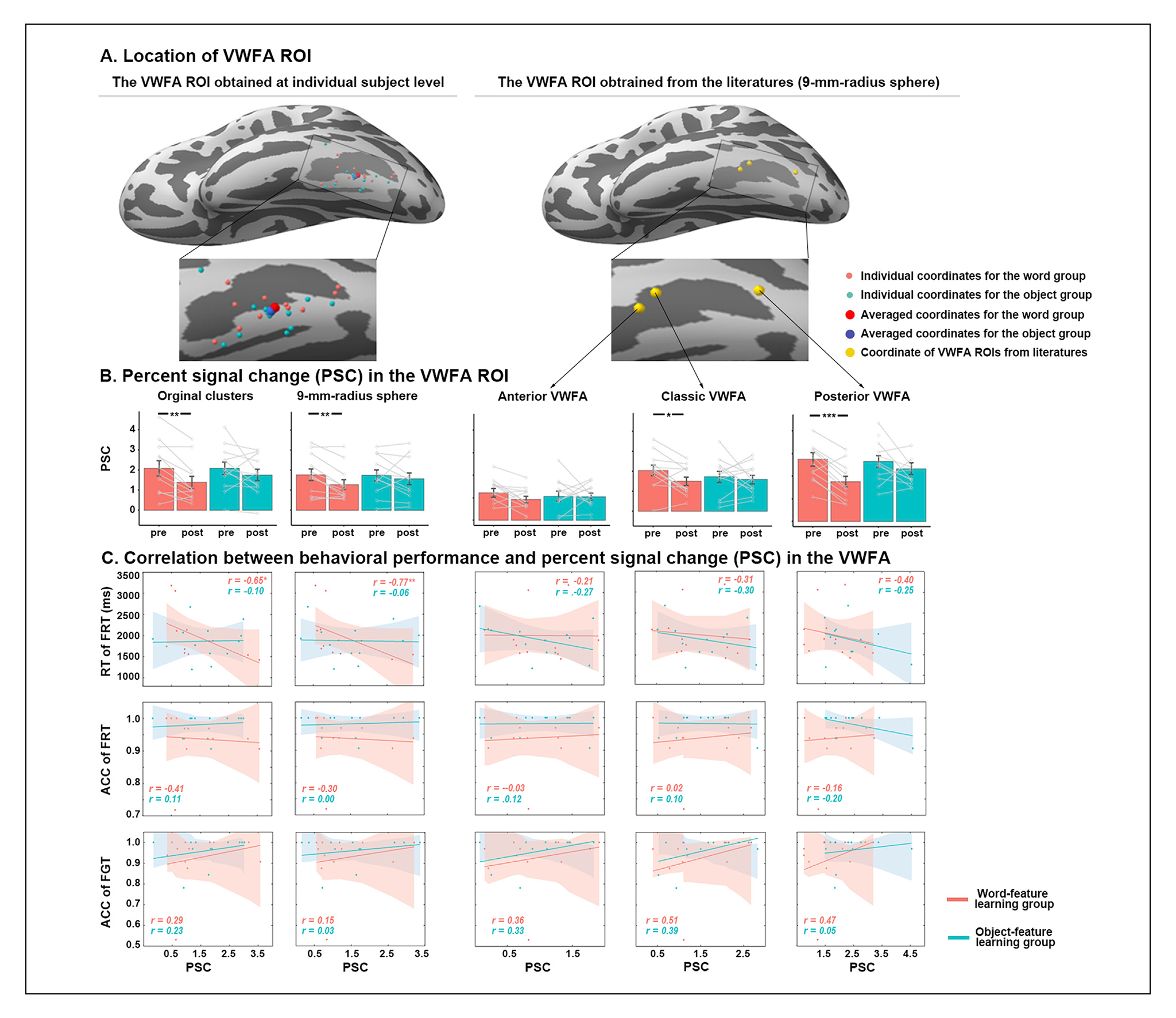
Figure. Pre- and post-training comparison of VWFA activation when novel objects are learned as characters versus as objects.
Major findings:
Li M, Xu Y, Luo X, Zeng J, Han Z*. (2020). Linguistic experience acquisition for novel stimuli selectively activates the neural network of the visual word form area. Neuroimage, 215: 116838. PDF
Wang, X., Peelen, M. V., Han, Z., He, C., Caramazza, A., & Bi, Y.. (2015). How visual is the visual cortex? comparing connectional and functional fingerprints between congenitally blind and sighted individuals. Journal of Neuroscience the Official Journal of the Society for Neuroence, 35(36), 12545. PDF
Xiaosha, W., Alfonso, C., Peelen, M. V., Zaizhu, H., & Yanchao, B.. (2015). Reading without speech sounds: vwfa and its connectivity in the congenitally deaf. Cerebral Cortex (9), 2416. PDF
Zheng, L., Chen, C., Liu, W., Long, Y., & Lu, C.. (2018). Enhancement of teaching outcome through neural prediction of the students' knowledge state. Human Brain Mapping, 39(2), 3046. PDF